On Bringing Readers to the Table

Food has always occupied a privileged place in my stories. Whether it’s Ohio teens taking refuge in a diner after surviving a wizard attack, a street thief in a mountain town bringing meat buns home to his family, an embattled princess who wonders if she should employ a taster, or an Appalachian family sharing Thanksgiving in hard times, food is part of the fabric of time and place.
Every writer brings their own experiences to story, and my food focus may reflect the fact that I was raised by a scratch cook, I’ve been a food gardener since childhood, and I subsequently chose nutrition and dietetics as a career. My first publications were feature articles and essays about food and health.
When my first agent read a draft of the book that became The Warrior Heir, she returned it to me, having crossed out long passages describing meals. NOBODY CARES, she wrote in the margin. When the aforementioned teens are digging in at the diner, she wrote, HOW CAN THEY EAT? THEY WERE JUST ATTACKED BY WIZARDS IN A GRAVEYARD. And I thought, have you ever lived with a teenage boy? Danger only whets the appetite.
I eventually found a new agent. But I did cut down on the food descriptions.
In high fantasy, such as my Seven Realms and Shattered Realms series, the trope is that characters always eat stew in taverns. Generic, non-specific stew, perhaps with a tankard of ale. That just reflects a lack of imagination and a missed world-building opportunity. If I’m going to put readers in my world, I want them to taste it, too. And that requires research, unless you’re the sort that enjoys getting critical emails.
The Episcopal Cathedral in Cleveland used to host medieval dinners at the holidays. Each year, the setting and era changed, from Britain to Eastern Europe to Italy. The menu, tableware, if any, and music changed accordingly. It was a delicious education.
Setting stories in a world of your own creation offers a certain flexibility. I am unlikely to receive emails from folks living in Fellsmarch telling me that NOBODY drinks blue ruin any more. But, still, it’s important that there be a coherence to world-building in order to put readers into your setting. When describing foodways, consider terrain, climate, trade, economics, and technology. What foods would be available in a desert realm? What could you harvest from a marshland?
Mealtime is also a great opportunity to address issues of class and culture. In The Exiled Queen, reformed thief Han Alister attends the Dean’s Dinner at the Academy at Oden’s Ford, and discovers that there is a lot to learn.
It was a thin broth, with a bit of greens floating in it. Not much of a supper, Han thought, surprised. He’d expected a more lavish spread. Spooning some up, he blew on it to cool it off. It tasted smoky and salty, like dried mushrooms and onions.
I hope we get seconds, he thought. Or at least some bread to go with. He took a few more bites, then noticed that nobody else was eating.
Across the table, Micah gazed at him, fingers templed, one eyebrow raised. Mordra leaned over. “You’re supposed to wait until everyone is served and the dean has welcomed us,” she said, in a whisper loud enough to be heard at nearby tables. A titter rolled around the room.
Han put his spoon down, feeling the blood rush to his face.
It turned out that soup wasn’t supper. It was what came before supper. Supper was roast quail and potatoes and carrots and little cakes and fruit soaked in brandy and set aflame and three different wines and sweet spirits in tiny cups.
Though he tried to follow along with what others were doing, every so often, Han would pick up the wrong fork or eat things in the wrong order, or use the wrong sauce on the wrong thing, and Mordra would correct him in her player’s whisper, sending the room into silent convulsions of laughter.
My Viking Age duology (Runestone Saga) introduced me to the foodways of Nordic Europe. So much of that history was driven by climate. There was little flat ground for farming, and summers were too short to grow wheat, grapes, olives, and other staples of southern Europe. So the diet revolved around barley, rye, dairy, fish and game, pork and poultry, ale made from barley, mead distilled from honey, and wine made from fruits other than grapes. Plus whatever they could steal from the flatlanders further south.
My latest work is set in Appalachian Ohio in the 1870’s, so, in a way, it was like coming home to my roots. Even there, getting the technology right was the issue. What kind of cookstoves were common in midwestern farmhouse kitchens? What fuel did they use? What limitations did that impose? Or did they cook on the hearth?
How were foods preserved? How did the season of the year affect the food on the table? What would be served for a holiday meal in winter? Would farm kitchens have ice boxes to preserve leftovers?
In those days, the big meal was dinner, served at mid-day. Supper, the evening meal, was lighter--often soup, bread, milk, or leftovers from dinner. My beta readers were sometimes confused by this change in terminology. (Wait--They already had dinner—and now they’re having supper?)
I’m just nerdy enough to enjoy reading historic restaurant menus as a primary source. Hotel restaurant menus of the times offer an overwhelming variety of choices by modern standards—it was the Gilded Age, after all. How would a woman raised on a subsistence farm react when presented with that?
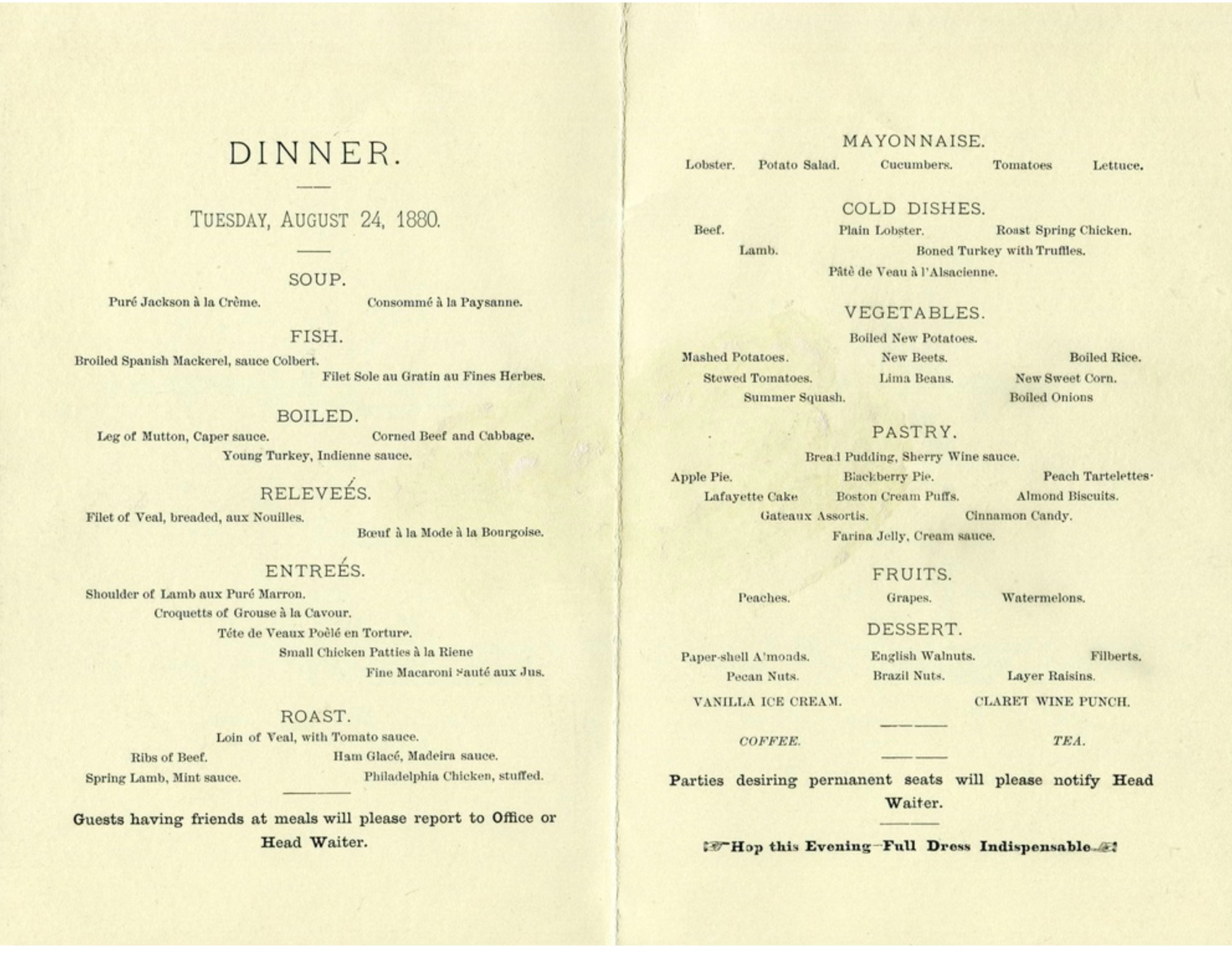
In this scene from Conjury, Betsy Downey goes to dinner at Isham House, the fanciest hotel in downtown Jackson, Ohio, with her lawyer, Gideon Hall.
It felt a little scandalous, having dinner with a man at a hotel.
The host nodded to Gideon and said, “Mr. Hall,” and led us to a corner table in the back. He pulled out a chair for me, and after I sat, dropped a napkin in my lap.
After he walked away, I said, “He knows you.”
“Yes.”
“You’ve been here before?”
“A few times. And I’ve represented Carson in court.” He picked up the menu, looked it over, then handed it to me. “Order whatever you like,” he said.
It was an entire page of dishes, some of them in French. Soups, fish, roasts, salads, pastries.
I stared, baffled. “Which ones are they serving today?”
“All of them,” Gideon said.
“They must have a lot of cooks,” I said.
“Or a few really fast cooks,” Gideon said, fighting back a smile. “Or one amazing cook.”
“I’ll have the spring lamb,” I said, and tried to hand back the menu.
“What else?” he said.
Isn’t that enough?
“Well, also the Philadelphia chicken.”
Gideon raised an eyebrow. “Any vegetables? Pastry?”
I looked again. “Boiled potatoes, stewed tomatoes—what is Lafayette cake?”
He shrugged. “Your guess is as good as mine. Order it and find out.”
“Lafayette cake and vanilla ice cream.” I figured that if the Lafayette cake didn’t work out, I’d still have the ice cream.
“When the waiter comes back, tell him all that,” Gideon said.
“Mr. Hall, are you assuming I’ve never been to a restaurant?” I said, my cheeks burning.
“Miss Downey, I try not to make any assumptions about you,” he said. “Do you like wine?”
I recently read Kim Michele Richardson’s Book Woman of Troublesome Creek. It is set in Depression-era eastern Kentucky, where impoverished families subsisted on beans, greens, and grits, with children developing pellagra and dying of starvation as a result. It is a survival tale as well as a love note to the power of books, and it makes real the consequences of poverty.
Laurel Thatcher Ulrich’s A Midwife’s Tale is a Pulitzer Prize-winning biography of 18th-century New England midwife Martha Ballard, based on her detailed diary. It provides a window into the “female economy” of the times, including food production, preparation, and preservation, an aspect generally neglected in mainstream histories.
Humans are visual creatures, so there is a tendency to over-rely on visual imagery in storytelling. But scent and taste are drivers of memory, and are often closest to the heart. Don’t forget to bring your readers to the table.
Culinary Institute of America menu collection http://ciadigitalcollections.culinary.edu/digital/collection/p16940coll1
Ah yes, a tankard of ale….it has been ages!
But do they get any mead? JK.