Helene Retrospective
Heroes and Healing in the Appalachians

It has been a year since Hurricane Helene devastated Western North Carolina. As you can imagine, local papers and television stations are airing memorials and retrospectives. This is mine.
The first thing to know about Hurricane Helene is that we didn’t see her coming. Really, we didn’t. People from places like Ft. Myers and Miami move to Asheville to get away from hurricanes. They come here because they are tired of constantly watching the horizon. They figure they’ll be safe on high ground, behind the ramparts of these old mountains.
My husband and I moved here because we were tired of living in the Ohio snow belt, because I wanted no part of the blistering heat of the flatland south, and because my roots are in the mountains, where I have always found a home. My husband had retired, and, as a writer, I knew I would find stories everywhere.
Our sons were already living in the North Carolina Piedmont, and that was a draw.
Long-timers could tell you that Western North Carolina had been ambushed by hurricanes before. The “Great flood of 1916” was caused by the remnants of a hurricane. In 2004, Tropical storms Ivan and Frances combined to drop several feet of rain, cause widespread flooding, destroy 140 homes, and kill 11 people. After that, flooding mitigation measures were implemented to prevent a repeat. In 2016, the City of Asheville issued a report with the optimistic headline, 100 Years After the Flood of 1916, Asheville Is Ready for the Next One.https://www.ashevillenc.gov/news/100-years-after-the-flood-of-1916-the-city-of-asheville-is-ready-for-the-next-one/
And the weather gods laughed.
In 2021, we had a final warning in the form of Tropical Storm Fred, that dumped 12 inches of rain in Western North Carolina, leaving 6 people dead due to flooding. Farmers in Haywood County were especially hard hit by flooding from the Pigeon River—crops and topsoil swept away, fencing, barns and other structures destroyed.
It’s easy enough to say, “Don’t farm in the floodplain,” but, due to climate change, nobody knows where the floodplain is any more. In the mountains, the richest farmland is in the river valleys, and it is the only place flat enough to plant.
That’s the only place to build railroads, roads, cities and towns, too. That makes them vulnerable when the rains come heavy and hard.
Biltmore Village, built in the 1890’s by George Vanderbilt at the confluence of the Swannanoa and French Broad Rivers, routinely flooded in heavy rains. We viewed it as a nuisance, but should have seen it as a warning as the floods grew worse and more frequent. Climate change, y’all. We all know it’s happening, even as our government tries to handwave it away.
Should we have known what was coming? Based on past history, anyone could have predicted that it would rain again, and it would flood again.
But Helene? Nobody predicted Helene.
After six years in Asheville, fall had become my favorite time of year—bright sunny days, clear, cool nights, and that riotous color display that I could see from my back deck. It was always crowded with tourists, but I could take refuge at home. Maybe you’ve heard of “Black Friday,” when retail stores finally break even in the frenzy of the holiday shopping. In Asheville, it’s during September and October that stores, restaurants, hotels and attractions make enough money to sustain them all year long.
September, 2024, however, had already become a mean season for our family. Our healthy, athletic, 39-year-old son Eric had suffered a stroke, the probable result of trauma during a soccer game. He was back home, but needed countless outpatient visits, therapy sessions, and the like. He wasn’t allowed to drive, his wife Jess had to get back to work, and they had a three-month-old son.
So on September 25, when Helene was still spinning in the Gulf of Mexico, I drove to Raleigh, NC, where they lived, to help out, leaving my husband Rod and our pup at home.
It was already raining. In fact, on that Wednesday, before Helene came ashore far to the south, our home rain gauge showed 4.45 inches of rain.
By the time I arrived, Eric was back in the hospital with worsening symptoms. We spent all day Thursday at the community hospital trying to get him seen by a neurologist (they had no neurologists, apparently!) We finally busted him out and took him to Duke University Hospital. I sat with him in the ED there until he was seen by a neurologist and admitted.
I was all but giddy. My son saw a neurologist! Things have to improve.
Meanwhile, back home, the rain continued. Rod was supposed to help set up the NC Arboretum Plant Sale. They hoped maybe they could still have it if it would only stop raining. That’s how little we knew. On Thursday it rained 5.78 inches. Thursday night, the power went out, not to return for weeks.
All of this happened before Helene actually arrived on Friday September 27. A low-pressure weather system associated with the storm had set up that funneled moist tropical air into our mountains, dropping buckets of rain that funneled into our creeks and rivers. The French Broad and Swannanoa Rivers were already out of their banks, and it would get worse.
All night long, the storm raged. Our dog Loki kept peeking over the side of the bed at my husband as if to say, “You got this? You sure?
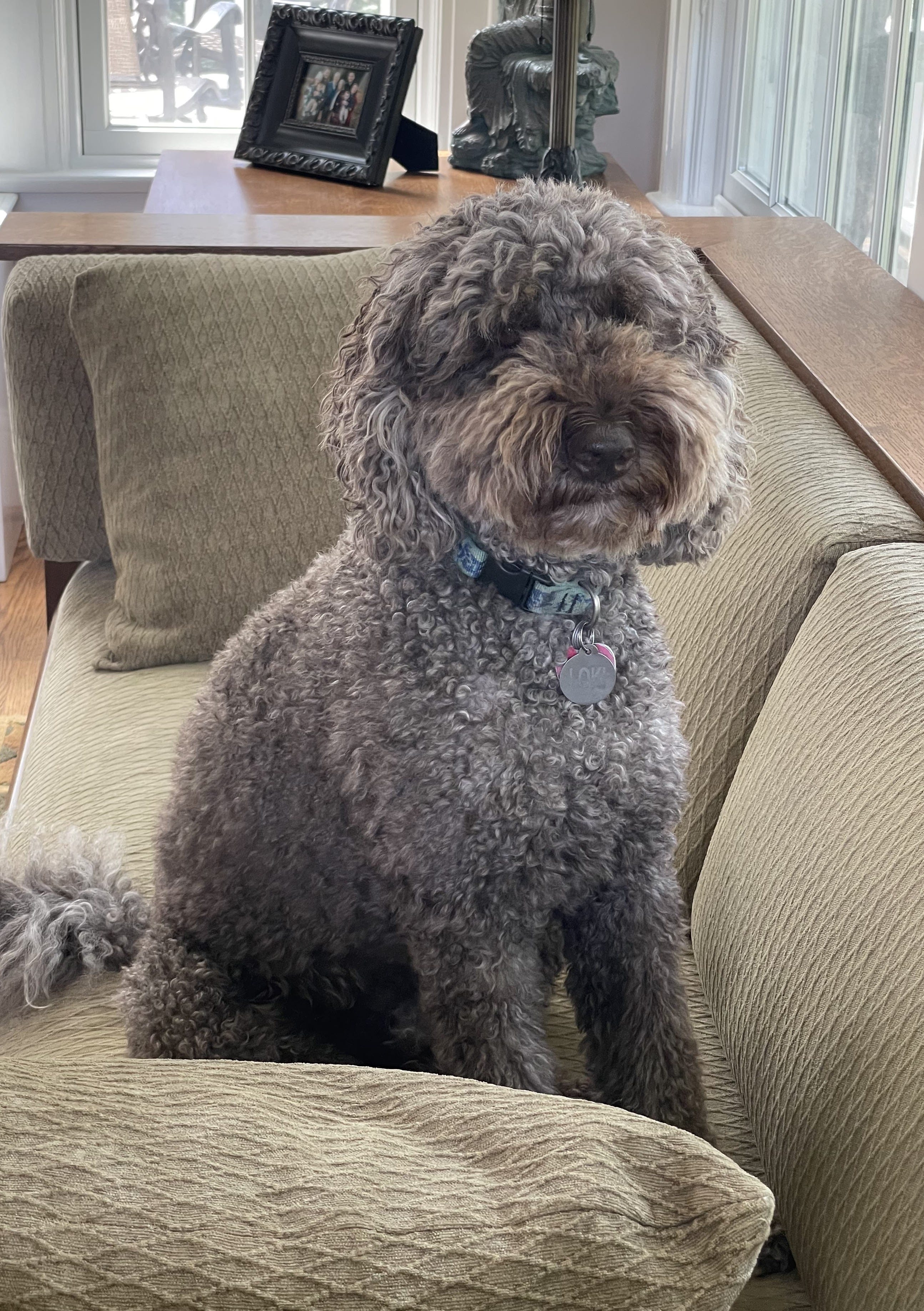
On Friday, Rod and Loki went out to reconnoiter in the rain. (Friday 4.11 inches.) This is where Helene becomes a tale of two cities—the high ground and the slopes and river valleys. Ours is an older neighborhood on relatively high, flat ground, with tree-shaded streets. Flooding was limited, but nearly half the trees had been knocked down. Across the street, our neighbor’s house had been hit by not one but two trees—in the front and in the back. One of our trees fell on our neighbor’s driveway. Fortunately, it missed the car. Unfortunately, that car was a loaner. Their actual car was at the dealer’s, which turned out to be underwater
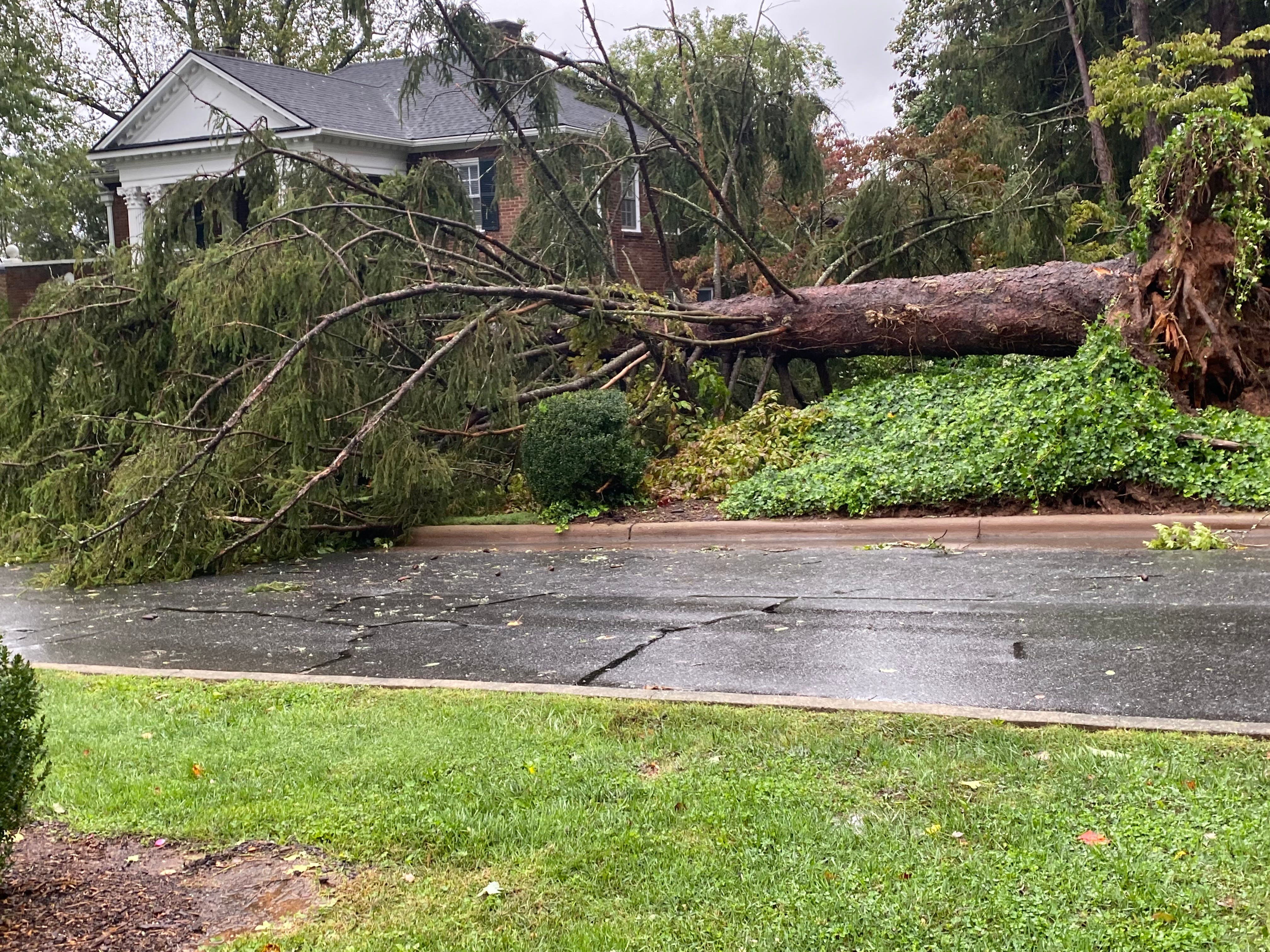
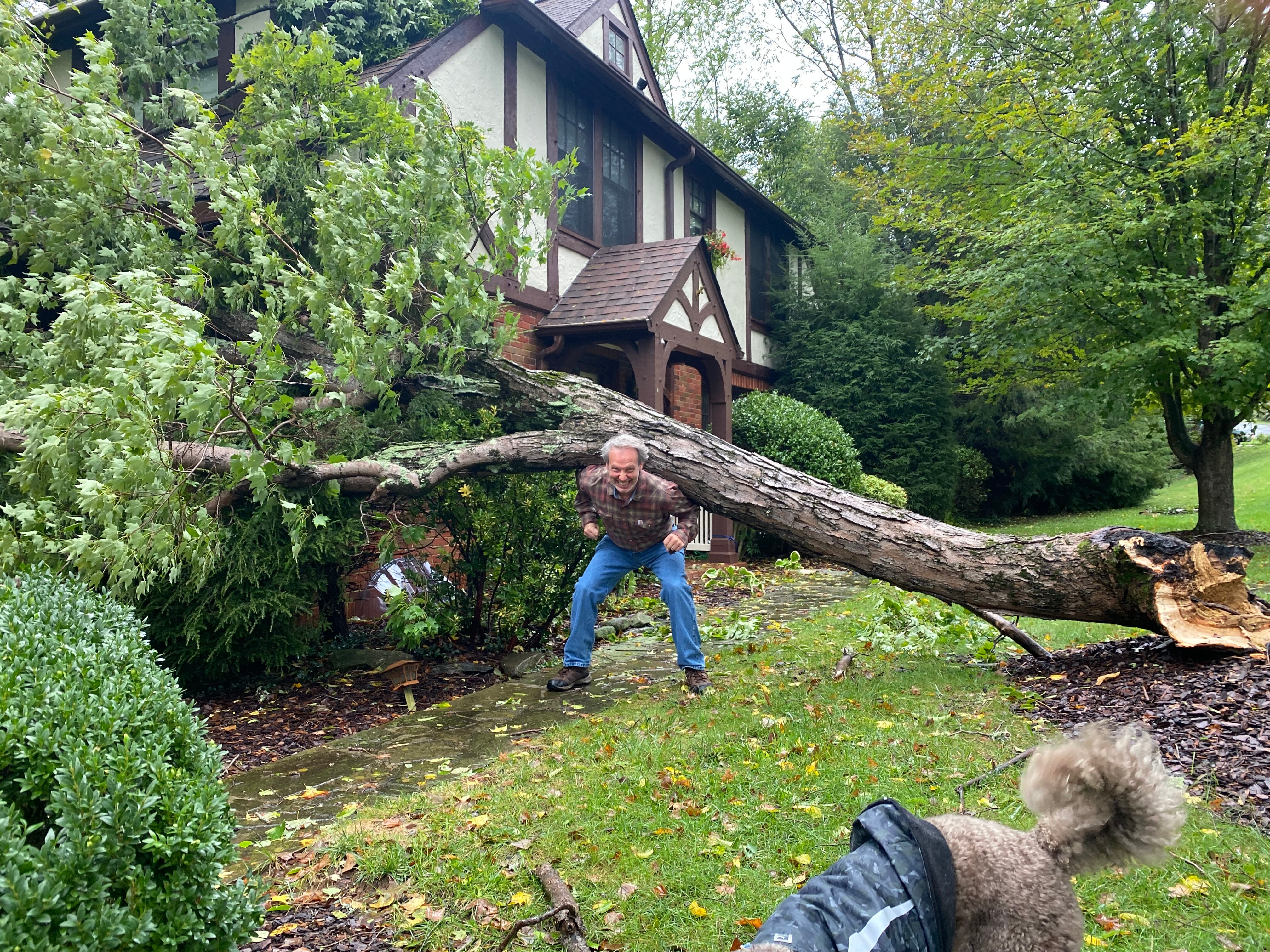
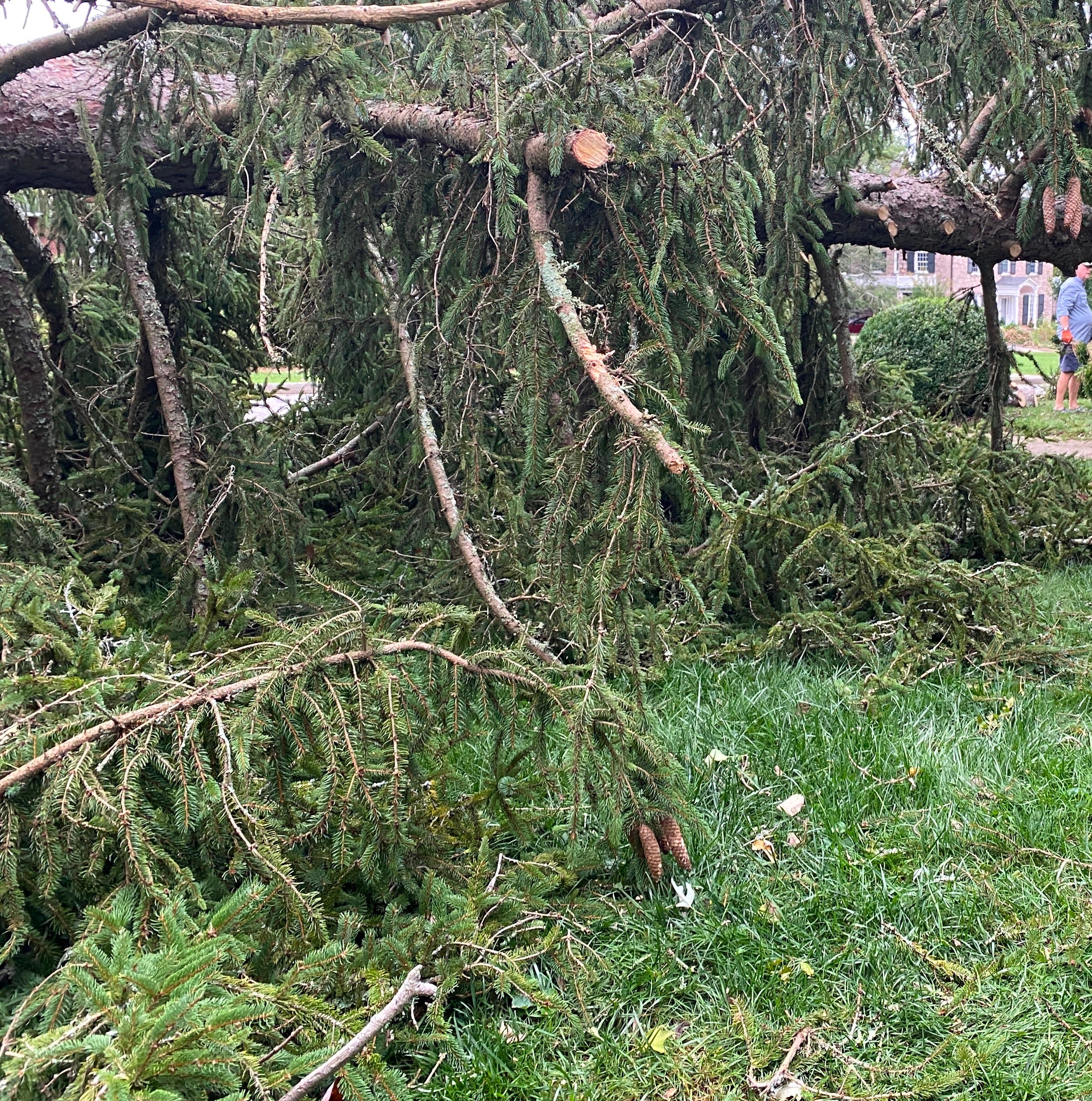
All around, the trees that had been such a blessing now blocked driveways and streets and sprawled over flattened cars. In places the root balls had tipped up, out of the saturated soil, lifting sidewalks and breaking pavement. Chainsaw heroes emerged, cutting through massive trunks, dragging leafy crowns out of roadways.
I’m told that Buncombe County, where I live, lost 50% of its trees to the storm.
The water went out mid-day, not to be fully restored until late November. Rod had filled the bathtub; one neighbor had a hot tub full of water, another with a pool was willing to share. The atmosphere was resolute, convivial, alive with the pioneer spirit. We don’t have power or water or cell service, but at least we can flush our toilets!
What they didn’t know was that all around them, people had it much, much worse.
An afternoon of chainsaw work opened the roads enough for our next door neighbors to get out and check on their business. They returned quiet, somber-faced, with heart-wrenching photos. “It’s really bad,” they said.
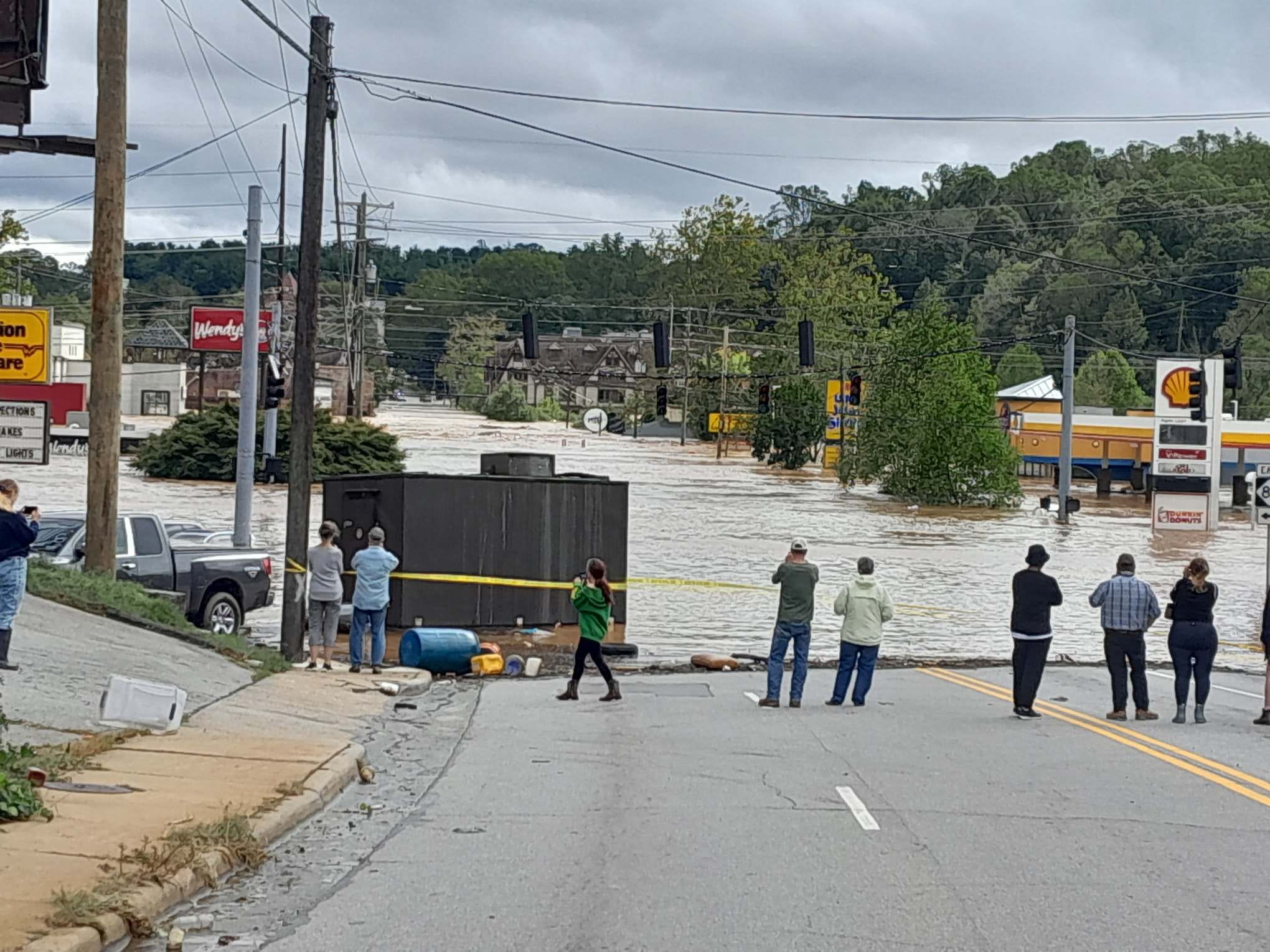
Until then, none of them knew how bad it was elsewhere.
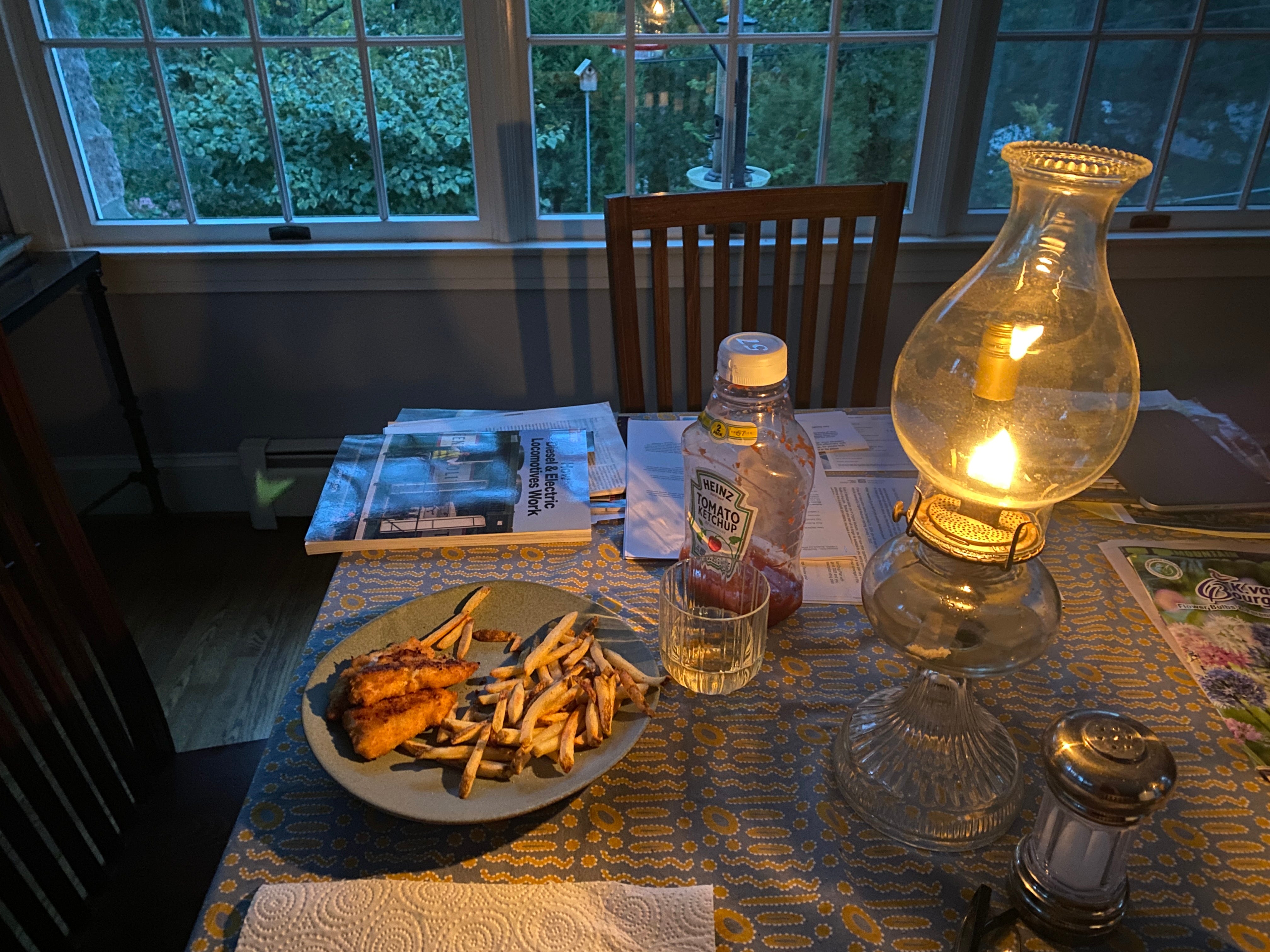
Rod cooked a thawing pizza on the gas grill and had dinner by lanternlight.
Meanwhile, in Raleigh, I was watching footage he hadn’t seen. The River Arts District, all but destroyed. Biltmore Village underwater. Marshall and Lake Lure Village washed away. Maps of flooding and images of roads fallen into gorges. Fast water rescues in familiar neighborhoods.
I kept calling. I could not reach my husband.
The next morning, my phone rang. It was Rod. The connection lasted long enough for him to say, “We’re all right. The roads are blocked. Don’t come here.” And that was it until two days later, when he called from South Carolina to say, “I found a way out. I’m coming there.”
Later that day, they arrived: terrified pup, exhausted husband, freezer salvage and all.
We ended up staying in the Raleigh area another month, driving Eric to appointments, cooking, helping out any way we could, following events from there. My calendar from September and October of 2024 is still filled with our best-laid plans. I had a book release for Bane of Asgard scheduled at Malaprops October 22. That was cancelled, and my book launched like a small boat into the storm, a flash on the horizon.
That’s when the politics and rumors began. Don’t accept money from FEMA—they’re trying to steal your land for precious minerals. Doug Emhoff (remember him? Kamala’s husband?) is trying to steal your land for precious minerals. The Biden administration is using FEMA money to house illegals. They were turning the red tape, frustrations, delays and shortages common in times of disaster into something darker. One man with a long gun was arrested because he was out hunting FEMA workers. They were no longer allowed to go door-to-door.
It made me crazy. I confronted it wherever I could.
Trump came to Western North Carolina in October, saying FEMA’s rescue effort was “all but non-existent.” (At that point, FEMA had provided more than $123 million to more than 90,000 households in North Carolina.) After Trump won the election, he came back to Western North Carolina, suggesting he might dismantle FEMA altogether.
He’s been as good as his word. Since the beginning of 2025, FEMA has lost 2000-2450 full-time workers, about a third of its work force (GAO.) It faces billion dollar cuts in its grant funding programs. Money already appropriated by Congress has been held up by requirements that disbursements be individually approved by the head of the Department of Homeland Security.
There have been so many heroes: those who’ve pitched in, despite losing everything. The folks that wielded chainsaws and cleared roads and carried out rescues in small boats. Volunteers who’ve tarped over damaged houses to keep the weather out. Local non-profits like Beloved Asheville and Manna Food Bank, who lost their warehouse to the Swannanoa River but were up and running within days with a new building at the Farmer’s Market. Jose Andres’ World Central Kitchen, partnering with shuttered restaurants to get meals out to people.
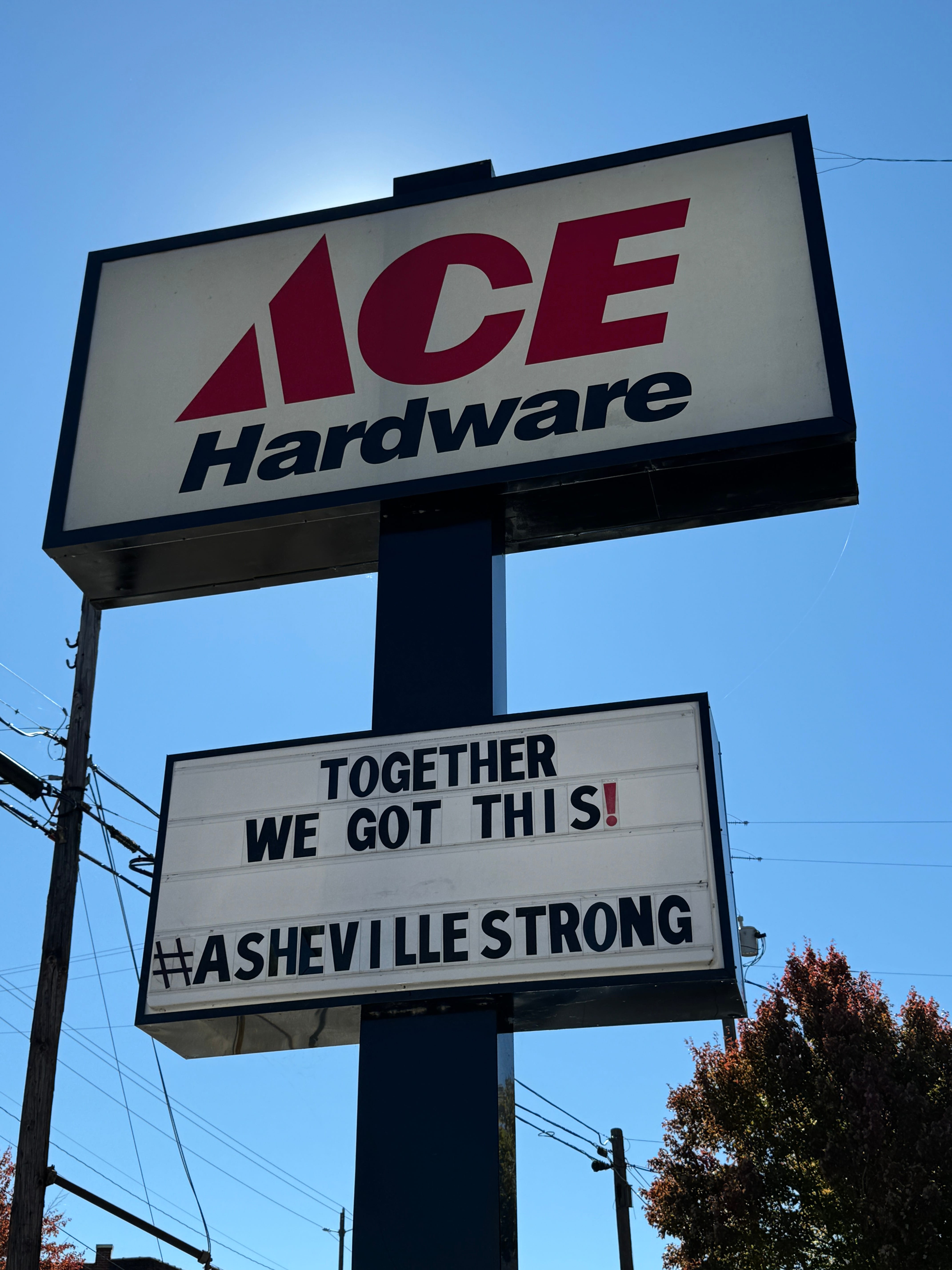
Volunteers and staff at Pisgah Legal, who helped people navigate insurance, legal claims, and government programs. Faith-based groups like Samaritan’s Purse and Asheville-Buncombe Community Christian Ministry. And, yes, FEMA staff and the Army Corps of Engineers who were on the ground from the beginning and stayed for months, helping with paperwork, disbursing temporary grants, and providing the expertise Asheville and Buncombe County needed to restore its broken water systems. The city is still waiting for some of that promised reimbursement.
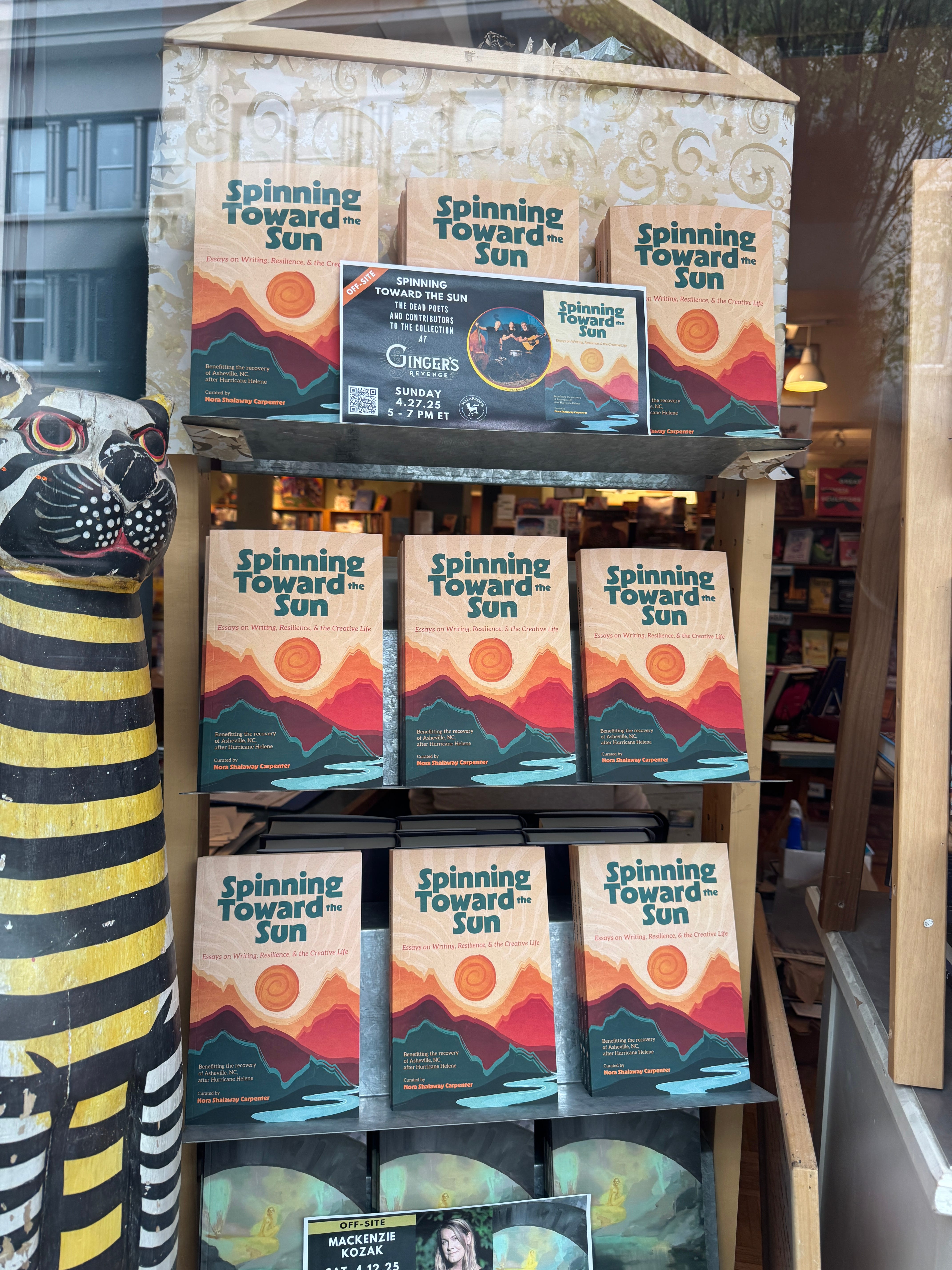
I contributed to Spinning Toward the Sun, a collection of writers’ essays edited by Nora Shalaway Carpenter with proceeds going toward Helene Relief.
To my mind, one of the worst cons ever perpetrated on the American people is the notion that government is never here to help—only get in the way. There are some catastrophes so large, they require the support and expertise only the federal government can provide, with the costs shared nationwide. The covenant has been that North Carolina and Georgia and California will pay for recovery in Florida and Texas, and that they will be there for us when we need help. Much of the “red tape” we complain about was put in place by people who want to make sure that taxpayers are not being ripped off.
A year later, my feelings after Helene are “guiltitude.” I feel both guilt and gratitude that I escaped the devastation and loss of life that was visited on so many people who did not deserve it. Because nobody deserved this, no matter who they voted for, or what gods they worship. Nobody deserved this because they stayed in the holler they’d occupied for six generations or lived in a camper by the river because it had always been fine before. Nobody deserved to have a mountain slide down on top of them and rip their screaming children from their arms. I will fight anyone who says different.
What is it with people who want to blame the victim? Is it because they want to absolve themselves of the responsibility to pitch in? Because plenty of people have pitched in, even some of those who have the least and lost the most.
And what is the role of those of us who came through this storm, forever marked, but intact? We bought a thunder shirt for our traumatized dog—is there one big enough for an entire community?
We can look at our own skills, our own resources, and ask, What can I do? How much can I give? How can I help? We can speak out against disinformation, reach out to politicians early and often, and do whatever we can to make sure that the hard-working people of this region are not betrayed and forgotten as they have been so many times before.
Want to help? Come visit Asheville and Western North Carolina—you will receive a warm welcome. The Blue Ridge Parkway is now mostly open in the Asheville area, the downtown was virtually untouched, and even areas like the River Arts District are reviving. Biltmore and the Grove Park Inn are beckoning. Our mountains are achingly beautiful, and fall color is once again smudging the Blue Ridge. Places to the west of us like Cherokee were barely touched by the storm
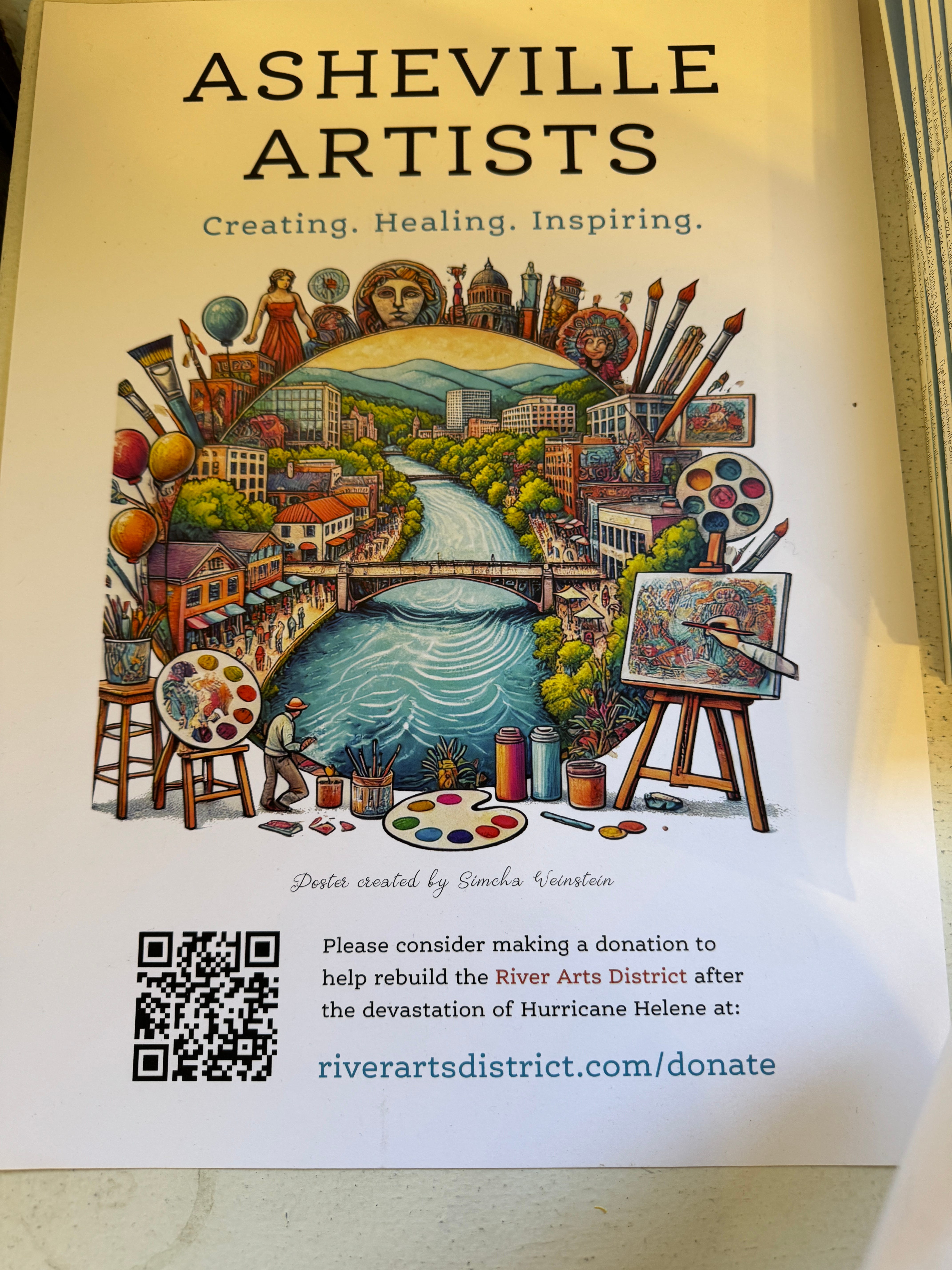
.Want to Give Money? Here are some places to start:
North Carolina Community Foundation https://www.nccommunityfoundation.org/nonprofits/disaster-relief-fund/hurricane-helene-response
Beloved Asheville https://www.belovedasheville.com
Baptists on Mission https://baptistsonmission.org
Habitat for Humanity https://www.habitat.org/nc/asheville/asheville-area-habitat-humanity
Manna Foodbank http://mannafoodbank.org
This made me cry - for the loss of course and the frustration I feel toward those who make things worse, but also so touched by the people sharing pool water and wielding chain saws to open roads. I'm so grateful we still have neighbors like that, and I mean "we" as in all of us, everywhere. It's an important reminder that kindness can go a long way in a crisis. Thanks so much for sharing your own story. The anniversary of this catastrophe is the perfect time to be mindful of what is working and what needs overhauled, as well as who still needs help. Thanks also for sharing the links where people can donate. We tend to forget about one disaster as soon as the next one comes along, especially if we are not directly impacted by it.
Great Post Cinda, thanks for the update and the personal features of what you and your family went through. Sorry your son Eric had to go through such an ordeal during the storm, but thankful you were there for him. I had a minor stroke in 2018 and see a vascular surgeon once a year for ultrasound to see how i am progressing. Thankfully mine was so mild, i didn't even know i had one. Hope Eric continues to improve and is able to enjoy life to it's fullest again. Rod did an amazing job while you were gone. Glad he and Loki were able to take things in stride. My hats off to him. Noone should have to go through what you and so many others did those days. My cousin Bud was in a local interview on TV for his ordeal surviving at Lake Lure til help arrived. I know that incident has scarred him and his wife for a lifetime. Always enjoy your posts. Sincerely, Don Marlowe